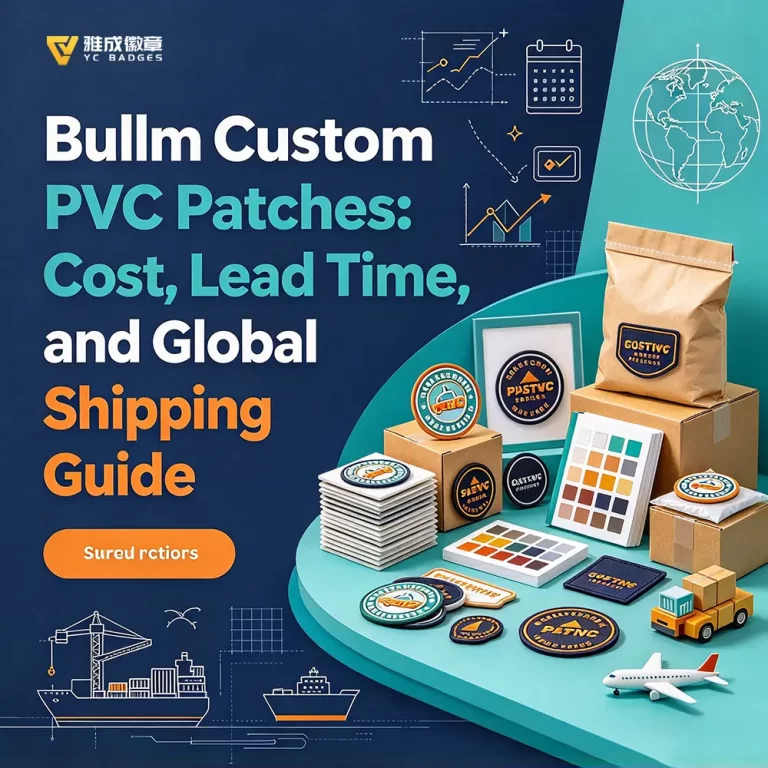
Bulk Custom PVC Patches: Cost, Lead Time, and Global Shipping Guide
Introduction
For military equipment suppliers, tactical gear brands, police and fire department distributors, and promotional product companies, ordering custom PVC patches in bulk involves more than selecting a design and negotiating a unit price.
Buyers must also consider tooling costs, minimum order quantities (MOQ), production schedules, quality control, packaging, international shipping, and import requirements.
A low unit price may not represent the lowest total procurement cost. Unexpected tooling charges, design revisions, production delays, and shipping expenses can all affect the final landed cost.
For international B2B buyers, understanding these factors before placing an order can help improve purchasing decisions and reduce supply chain uncertainty.
This guide explains how bulk custom PVC patches are priced, what influences manufacturing lead times, and how to plan global shipping for wholesale and OEM orders.
1. What Are Bulk Custom PVC Patches?
Bulk custom PVC patches are personalized molded patches manufactured in larger quantities for commercial, organizational, or institutional use.
They may feature custom logos, lettering, emblems, colors, shapes, and backing configurations.
Common buyers include:
- Military and defense equipment suppliers
- Police and law enforcement distributors
- Fire department equipment suppliers
- Tactical gear brands
- Outdoor equipment manufacturers
- Security companies
- Promotional product distributors
- Private-label merchandise brands
Unlike ready-made patches, custom PVC patches generally require design preparation and dedicated tooling.
For repeat orders, the original approved mold may be reusable, depending on its condition, design requirements, and the manufacturer’s tooling policy.
Bulk purchasing can help buyers distribute certain fixed production costs across a larger number of units.
However, the most suitable order quantity depends on actual demand, inventory requirements, and the supplier’s production capabilities.
2. What Determines the Cost of Bulk Custom PVC Patches?
The price of wholesale custom PVC patches depends on several variables.
Understanding these factors makes it easier to compare supplier quotations accurately.
Patch Size and Thickness
Larger patches generally require more PVC material.
Thickness, border structure, and the depth of molded details can also affect material consumption and production requirements.
For example, a compact logo patch and a large, multi-layer tactical patch should not be expected to have the same production cost.
Design Complexity
A simple design with clearly separated color areas may be easier to manufacture than a complicated design containing small text, multiple relief levels, and detailed illustrations.
More complex designs may require additional mold preparation and production controls.
Number of Colors
Color count can influence material preparation, molding operations, and production complexity.
Buyers should provide clear color references and confirm the manufacturer’s capabilities before finalizing the design.
2D vs. 3D Construction
Both 2D and 3D PVC patches can be produced in bulk.
Three-dimensional designs may require more complicated molds or manufacturing operations, depending on the artwork.
The cost difference should be evaluated using the actual design rather than assuming that every 3D patch is necessarily more expensive.
Backing Type
Common options include:
- Hook-and-loop backing
- Sew-on configurations
- Adhesive-backed options for suitable applications
- Other application-specific attachment systems
Backing material, attachment method, and inspection requirements can affect the final quotation.
Packaging Requirements
Bulk packaging is often simpler than individual retail packaging.
However, some brands and distributors require:
- Individual polybags
- Custom labels
- Barcode stickers
- Retail-ready packaging
- SKU separation
- Carton markings
These requirements should be included in the original quotation.
3. Understanding Mold Costs and Setup Charges
Custom PVC patches are generally manufactured using dedicated molds.
The mold defines the patch shape, dimensions, borders, and raised or recessed details.
A supplier may charge a separate tooling fee or include tooling costs in the overall quotation.
Before placing an order, ask:
- Is the mold fee included in the quotation?
- Will the mold be retained for repeat orders?
- Who owns the mold?
- How long will the manufacturer store it?
- Will design changes require new tooling?
- Are there additional setup charges for repeat production?
For brands expecting regular orders, tooling policies can have a meaningful effect on long-term procurement costs.
Important: A free-mold offer does not necessarily mean tooling has no cost. Buyers should compare the complete quotation, including unit pricing and any conditions attached to tooling discounts.
4. How Order Quantity Affects Unit Pricing
Bulk production can reduce per-unit costs because certain setup expenses are distributed across more pieces.
However, lower unit prices must be balanced against inventory carrying costs and demand uncertainty.
The following example illustrates how volume can affect a hypothetical quotation.
| Order Quantity | Illustrative Unit Price | Product Subtotal |
|---|---|---|
| 100 pieces | $1.80 | $180 |
| 300 pieces | $1.25 | $375 |
| 500 pieces | $1.05 | $525 |
| 1,000 pieces | $0.85 | $850 |
| 3,000 pieces | $0.70 | $2,100 |
These figures are hypothetical examples for explaining quantity-based pricing. They are not market quotations or guaranteed factory prices. Tooling, packaging, freight, taxes, and other charges are excluded.
Ordering 3,000 patches may offer a lower unit price than ordering 300, but the buyer must consider whether the additional inventory is commercially justified.
For tactical equipment brands and distributors, an appropriate ordering strategy should account for sales forecasts, reorder frequency, and warehouse capacity.
5. How to Calculate the Total Landed Cost
For international buyers, the factory unit price is only one part of the total procurement cost.
A more complete landed cost calculation may include:
Total Landed Cost = Product Cost + Tooling + Packaging + Freight + Insurance + Import Duties + Non-Recoverable Taxes + Customs and Handling Fees
The precise calculation depends on the agreed Incoterms, destination country, tax treatment, and logistics arrangements.
Example: A Hypothetical Bulk PVC Patch Order
| Cost Component | Example Amount |
|---|---|
| 1,000 PVC patches at $0.85 | $850 |
| Custom mold | $120 |
| Special packaging | $50 |
| International freight | $180 |
| Import duties and handling | $100 |
| Total estimated landed cost | $1,300 |
In this example:
Estimated landed cost per patch = $1,300 ÷ 1,000 = $1.30
Although the factory unit price is $0.85, the total estimated landed cost is $1.30 per patch.
The difference illustrates why international buyers should compare total procurement costs instead of focusing only on the quoted factory price.
Actual freight charges, duties, taxes, and handling costs must be confirmed for each shipment.
6. What Is the Typical Production Lead Time for Custom PVC Patches?
Production lead time is one of the most important planning factors for wholesale orders.
It depends on the design, mold requirements, sample approval, order quantity, factory capacity, and quality control procedures.
A typical manufacturing workflow includes:
Artwork review → Mold development → Sample production → Sample approval → Mass production → Final inspection → Packaging
For planning purposes, buyers may use the following illustrative schedule.
| Production Stage | Example Planning Allowance |
|---|---|
| Artwork review | 1–3 working days |
| Mold development | 3–7 working days |
| Sample production | 2–5 working days |
| Sample approval | Depends on buyer feedback |
| Mass production | 7–15 working days |
| Final QC and packaging | 1–3 working days |
These are illustrative planning allowances, not verified industry averages or supplier commitments. Some projects may take substantially longer, particularly when designs are complex, approval rounds are repeated, or factory capacity is constrained.
The schedule should be confirmed in writing with the manufacturer before the buyer commits to a customer delivery date.
7. What Can Delay a Bulk PVC Patch Order?
Even when the manufacturer has available production capacity, several issues can affect the delivery schedule.
Incomplete Artwork
Low-resolution images, unclear dimensions, and missing color specifications may require additional design work.
Providing production-ready artwork can help reduce unnecessary revisions.
Multiple Sample Revisions
Changes to colors, dimensions, lettering, or relief structure may require additional sample development.
In some cases, changes to the physical design may require mold modifications or replacement.
Large or Complex Orders
Orders containing many different designs, backing types, or packaging configurations may require additional production coordination.
Quality Issues
Defective products may need rework or replacement before shipment.
Allowing adequate time for inspection helps avoid shipping products that do not meet agreed specifications.
Shipping and Customs Delays
International transportation can be affected by carrier schedules, customs inspections, incomplete documents, seasonal congestion, and other factors outside the manufacturer’s direct control.
Buyers should include reasonable contingency time when planning product launches or contract deliveries.
8. How to Reduce Lead Time Without Sacrificing Quality
Reducing lead time is not simply a matter of asking the manufacturer to produce faster.
A more reliable approach is to eliminate avoidable delays throughout the project.
Recommended practices include:
- Provide complete vector artwork when available.
- Confirm dimensions, colors, and backing before tooling.
- Review digital proofs promptly.
- Approve physical samples without unnecessary delay.
- Avoid design changes after mass production begins.
- Confirm the production schedule in writing.
- Arrange shipping requirements before production is completed.
- Plan repeat orders before inventory becomes critically low.
For long-term OEM customers, retaining approved molds and production specifications can help simplify future orders.
However, repeat-order lead times should still be confirmed based on current factory capacity and material availability.
9. International Shipping Options for Bulk PVC Patches
International buyers commonly compare courier express, air freight, and ocean freight.
The best option depends on shipment size, destination, required delivery date, total cost, and customs arrangements.
Express Courier
International express courier services may be suitable for samples, smaller shipments, and urgent orders.
Advantages include shipment tracking and relatively straightforward parcel handling.
However, costs can become high when shipment weight or volumetric weight increases.
Air Freight
Air freight may be suitable for larger shipments that need faster transportation than ocean freight can generally provide.
Buyers should confirm whether quotations cover airport-to-airport or door-to-door service.
Customs clearance and local delivery may be charged separately.
Ocean Freight
Ocean freight can be economical for larger consolidated shipments, particularly when PVC patches are shipped together with other tactical equipment or promotional products.
However, transit time, port handling, customs clearance, and inland delivery should all be considered.
For relatively small patch orders, ocean freight may not be economical once minimum freight and destination handling charges are included.
Shipping Method Comparison
| Shipping Method | Common Use | Main Consideration |
|---|---|---|
| Express courier | Samples and smaller urgent orders | Higher cost per shipment |
| Air freight | Time-sensitive commercial shipments | Balance of speed and cost |
| Ocean freight | Larger consolidated shipments | Longer overall transit and handling |
| Freight consolidation | Multiple products or suppliers | Requires logistics coordination |
Shipping time and cost vary significantly by origin, destination, service level, and shipment characteristics. Obtain current quotations from carriers or freight forwarders rather than relying on fixed transit-time assumptions.
10. Understanding Incoterms for International PVC Patch Orders
Incoterms help define how buyers and sellers divide responsibilities for transportation, costs, and risk.
Common terms in international manufacturing transactions include:
EXW — Ex Works
Under EXW, the seller makes the goods available at the agreed location, while the buyer takes on substantial transportation and export-related responsibilities.
EXW may be less convenient for buyers unfamiliar with export procedures in the supplier’s country.
FOB — Free On Board
FOB is intended for sea and inland waterway transport. Under the agreed rules, the seller delivers the goods on board the vessel at the named port.
For containerized cargo, FCA may be more appropriate in many circumstances.
FCA — Free Carrier
Under FCA, the seller delivers the goods to the carrier or another nominated party at the agreed place.
It can be used across different transport modes.
DAP — Delivered at Place
Under DAP, the seller arranges transport to the named destination, while the buyer generally handles import clearance and applicable import duties and taxes.
DDP — Delivered Duty Paid
Under DDP, the seller takes on extensive responsibilities, including import clearance and applicable duties and taxes.
However, DDP may not be practical in every destination because import registration and local tax rules can restrict who may act as importer.
Procurement Tip: Always specify the named place and Incoterms version in the purchase agreement, such as FCA [named place], Incoterms 2020.
Confirm who is responsible for freight, insurance, customs clearance, duties, taxes, and final delivery.
11. Customs Documentation for International Orders
Accurate documentation is essential for international shipping.
Depending on the destination and shipping arrangement, commonly required documents may include:
- Commercial invoice
- Packing list
- Air waybill or bill of lading
- Customs declaration
- Country-of-origin information
- Product description and material composition
- Applicable certificates or declarations when required
The appropriate customs classification must be determined using the actual product construction and the importing country’s tariff rules.
Do not assume that all PVC patches share one universal HS code.
For shipments to the United States, European Union, or other major markets, importers should verify current customs requirements with a qualified customs broker or relevant authority.
Products bearing military, police, or other official insignia may also require appropriate authorization to reproduce and distribute the artwork.
12. Packaging and Carton Planning for Bulk Orders
Packaging affects product protection, warehouse handling, shipping cost, and distribution efficiency.
Bulk Packaging
Bulk packaging may be suitable for buyers who will use the patches in their own manufacturing operations or distribute them internally.
Patches should be packed to reduce deformation, contamination, and unnecessary handling damage.
Individual Packaging
Retail brands and promotional distributors may prefer individual bags, branded cards, or labels.
This can make inventory management and resale easier, although it increases packaging requirements.
SKU Separation
Orders containing multiple designs should have clear SKU identification.
The packing list should distinguish quantities by design, color, size, or other relevant specifications.
Carton Requirements
Confirm:
- Quantity per carton
- Gross and net weight
- Carton dimensions
- Carton labels
- SKU information
- Palletization requirements, if applicable
Accurate carton information also helps freight forwarders calculate shipping costs.
13. Quality Control Before International Shipment
For overseas B2B orders, discovering defects after delivery can be expensive.
A pre-shipment inspection should therefore be included in the procurement process.
Typical checks may include:
Appearance: Verify colors, borders, lettering, molded details, and surface condition.
Dimensions: Compare finished patches with approved measurements and tolerances.
Backing: Confirm backing type, placement, and attachment quality.
Quantity: Check quantities against the purchase order.
Packaging: Confirm labels, packing methods, and carton quantities.
Documentation: Review the invoice, packing list, and shipping instructions.
Buyers may also specify a sampling inspection plan, such as one based on an agreed acceptance quality limit (AQL), when appropriate.
The inspection method, sample size, defect categories, and acceptance criteria should be defined in advance rather than assumed.
For further guidance, see PVC Patch Quality Control Standards for Military Contracts.
14. Bulk PVC Patch Procurement for Military and Tactical Buyers
Military and tactical equipment buyers may have requirements beyond those of ordinary promotional merchandise.
For example, a procurement specification may address:
- Approved artwork and insignia
- Exact dimensions
- Color references
- Material characteristics
- Hook-and-loop attachment
- Durability requirements
- Batch consistency
- Packaging and labeling
- Inspection records
- Contract delivery schedules
Not every military-related purchase is governed by the same standard.
Buyers should follow the actual contract specifications and avoid assuming that a general-purpose PVC patch automatically meets military procurement requirements.
A manufacturer should be able to explain its production capabilities and identify any requirements that need independent testing or additional verification.
15. How to Choose a Reliable Bulk PVC Patch Manufacturer
Selecting a supplier is about balancing cost, quality, communication, and delivery reliability.
Before placing a wholesale order, evaluate the following factors.
Manufacturing Capability
Can the supplier manufacture the required design, dimensions, relief structure, and backing?
Transparent Quotation
Does the quotation clearly identify unit prices, tooling charges, packaging, shipping terms, and any additional fees?
Sampling Process
Can the buyer approve a physical sample before mass production?
Quality Control
Does the supplier perform documented inspections and retain approved specifications?
Production Capacity
Can the supplier realistically meet the requested order quantity and delivery schedule?
Export Experience
Can the supplier prepare accurate commercial documentation and coordinate with the buyer’s nominated logistics provider?
Repeat-Order Support
Can the supplier maintain mold records, artwork references, and production specifications for future orders?
These considerations help buyers compare the overall value of different manufacturers rather than simply choosing the lowest unit price.
16. Bulk PVC Patch Ordering Checklist
Before confirming an order, review the following checklist.
Product Specifications
- Artwork and logo approved
- Size and shape confirmed
- 2D or 3D design confirmed
- PVC colors specified
- Backing type confirmed
- Packaging requirements documented
Pricing
- Unit price confirmed
- MOQ confirmed
- Mold fee confirmed
- Sample charges confirmed
- Packaging costs confirmed
- Payment terms agreed
Production
- Sample approval completed
- Production schedule confirmed
- Quality requirements documented
- Inspection arrangements confirmed
- Reorder and mold-retention terms clarified
International Shipping
- Shipping method selected
- Incoterms agreed
- Named delivery location confirmed
- Freight quotation obtained
- Import responsibilities confirmed
- Customs documents reviewed
- Delivery contingency considered
A complete purchase order should reflect the final agreed requirements.
17. Frequently Asked Questions About Bulk Custom PVC Patches
What is the MOQ for bulk custom PVC patches?
MOQ varies by manufacturer, design, size, production method, and order requirements.
Buyers should request a quotation based on the actual artwork and quantity rather than assuming a universal minimum order.
Are bulk PVC patches cheaper per piece?
Larger quantities often reduce unit pricing because certain setup costs can be distributed across more products.
However, the total purchase cost increases with quantity, and buyers should consider inventory requirements.
How long does bulk PVC patch production take?
Production time depends on artwork approval, mold development, sampling, order quantity, factory capacity, and inspection.
Ask the manufacturer for a written schedule that separates sample development, mass production, and shipping.
Can I order several patch designs in one shipment?
Yes, suppliers may be able to manufacture multiple designs and consolidate them into one shipment.
However, each design may have its own tooling, MOQ, and production requirements.
Can I reuse the mold for repeat orders?
Many manufacturers can retain molds for future production, but mold ownership, storage, condition, and reuse charges should be agreed in advance.
Which shipping method is best for wholesale PVC patches?
Express courier can be practical for small urgent orders, while air freight or consolidated freight may be more suitable for larger shipments.
The best choice depends on total shipment weight, dimensions, destination, delivery deadline, and current freight quotations.
How can I avoid unexpected import costs?
Confirm the agreed Incoterms, customs classification, importer responsibilities, duties, taxes, and destination charges before shipment.
A freight forwarder or customs broker can help clarify the relevant requirements.
Conclusion
Ordering bulk custom PVC patches requires careful coordination between product design, manufacturing, quality control, and international logistics.
The lowest quoted unit price does not always result in the lowest landed cost. Tooling fees, packaging, shipping, import charges, and inventory requirements can significantly affect the final procurement decision.
For military equipment suppliers, tactical gear brands, police and fire department distributors, and private-label businesses, a successful sourcing process should begin with clear product specifications and a realistic production schedule.
Working with a manufacturer that provides transparent quotations, sample approval, consistent quality control, and reliable shipping coordination can make repeat purchasing more predictable.
Whether you are developing a new custom patch collection or sourcing larger quantities for ongoing distribution, comparing total costs and confirming delivery responsibilities early can help reduce avoidable risks.
Looking for a bulk custom PVC patch manufacturer?
Share your artwork, required dimensions, backing type, estimated order quantity, destination country, and target delivery date. Our team can review your project requirements and provide a quotation covering manufacturing, tooling, packaging, and available shipping arrangements.