
Introduction: Why This Comparison Matters for Field Operations
When procurement teams evaluate insignia options for field uniforms, one question consistently arises:
Should we choose military PVC patches or traditional embroidered patches?
While embroidered patches have been used for decades in ceremonial and dress uniforms, operational environments demand durability, weather resistance, and long-term cost efficiency.
This guide compares military PVC patches vs embroidered patches in real-world field use conditions — helping military units, law enforcement agencies, and tactical gear brands make informed sourcing decisions.
What Are Military PVC Patches?
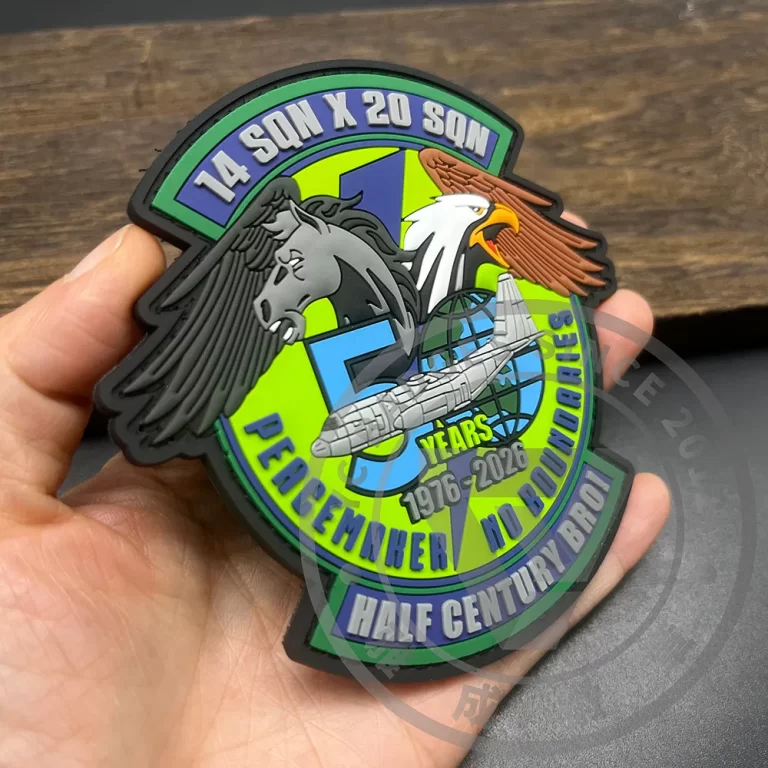
Military PVC patches are made from soft molded polyvinyl chloride material. Instead of thread stitching, they are created using injection molding and layered color filling.
Key characteristics:
- Waterproof material
- 2D or 3D raised design
- Fade-resistant color
- Velcro hook backing compatibility
- High durability under harsh conditions
They are commonly used on:
- Tactical vests
- Combat uniforms
- Field backpacks
- Plate carriers
- Morale gear
What Are Embroidered Patches?
Embroidered patches are made by stitching thread onto fabric backing. They have a classic textured look and are often used for:
- Dress uniforms
- Formal insignia
- Historical-style patches
- Ceremonial events
While visually traditional, their performance differs significantly in field conditions.
Head-to-Head Comparison for Field Use
1️⃣ Durability in Harsh Environments
Military PVC Patches
✔ Waterproof
✔ Mud resistant
✔ Do not fray
✔ Withstand UV exposure
✔ Maintain structure under pressure
Embroidered Patches
✖ Absorb moisture
✖ Threads may loosen
✖ Edges can fray
✖ Colors may fade over time
For tactical deployment and outdoor missions, military PVC patches clearly outperform embroidery.
2️⃣ Performance in Rain, Sweat & Mud
Field uniforms are exposed to:
- Rain
- Humidity
- Sand
- Sweat
- Snow
PVC patches can be wiped clean instantly. Embroidered patches absorb moisture and may retain dirt, affecting appearance and longevity.
For law enforcement or special operations units working in unpredictable weather, PVC provides superior resilience.
3️⃣ Design Detail & Visual Impact
3D PVC Patches
- Raised lettering
- Layered color separation
- High-definition logos
- Tactical subdued color schemes
Embroidered Patches
- Limited by thread thickness
- Fine details may blur
- Color blending constraints
When units require precise insignia reproduction or modern tactical aesthetics, PVC allows sharper, more dimensional results.
4️⃣ Attachment & Modularity
Most modern field uniforms use Velcro panels.
Military velcro patches made from PVC:
- Maintain firm hook backing
- Keep shape over repeated removal
- Resist curling
Embroidered patches can bend or distort over time with repeated Velcro attachment cycles.
Modular tactical gear systems strongly favor PVC construction.
5️⃣ Long-Term Cost Efficiency
While embroidery may have slightly lower initial mold-free setup costs, PVC patches offer better lifecycle value.
Military PVC patches typically:
- Last longer
- Require fewer replacements
- Maintain consistent quality in repeat orders
For procurement teams managing bulk annual orders, this reduces long-term operational expenses.
6️⃣ Weight & Comfort
PVC patches are slightly heavier than embroidered patches. However:
- The difference is minimal at standard sizes (2–4 inches)
- Modern soft PVC remains flexible
- Comfort impact is negligible in field applications
For dress uniforms, embroidery may feel lighter. For field gear, durability outweighs minor weight differences.
When Are Embroidered Patches Still Preferred?
Despite PVC’s operational advantages, embroidery remains suitable for:
- Ceremonial uniforms
- Heritage insignia
- Formal events
- Traditional presentation settings
Some units choose a hybrid approach:
- Embroidery for dress uniforms
- Military PVC patches for field use
This dual-application strategy is increasingly common.
Industry Trend: Why Tactical Units Are Shifting to PVC
Across military, police, and private tactical brands in North America and Europe, PVC adoption continues growing due to:
- Modular gear systems
- Velcro-based uniforms
- Harsh environment requirements
- Modern branding aesthetics
As tactical operations evolve, insignia materials must evolve as well.
Quick Comparison Table
| Feature | Military PVC Patches | Embroidered Patches |
|---|---|---|
| Waterproof | ✔ Yes | ✖ No |
| Fray Resistant | ✔ Yes | ✖ No |
| 3D Design Capability | ✔ Excellent | Limited |
| Field Durability | ✔ High | Moderate |
| Ceremonial Look | Moderate | ✔ Traditional |
| Long-Term Value | ✔ Strong | Moderate |
Final Verdict: Which Is Better for Field Use?
For operational, tactical, and outdoor field environments:
Military PVC patches are the superior choice.
They provide:
- Greater durability
- Better weather resistance
- Cleaner visual detail
- Improved lifecycle cost efficiency
Embroidered patches remain valuable for formal settings — but for real-world deployment, PVC is now considered the industry standard.
Need Durable Custom Military PVC Patches?
If your unit or agency is reviewing insignia suppliers, consider working with an experienced OEM manufacturer that specializes in:
- Custom military PVC patches
- 3D tactical insignia
- Velcro-backed field patches
- Bulk procurement programs
Contact us to request:
- Free digital proof
- Production timeline
- MOQ details
- Sample evaluation
Built for field conditions. Engineered for durability.