
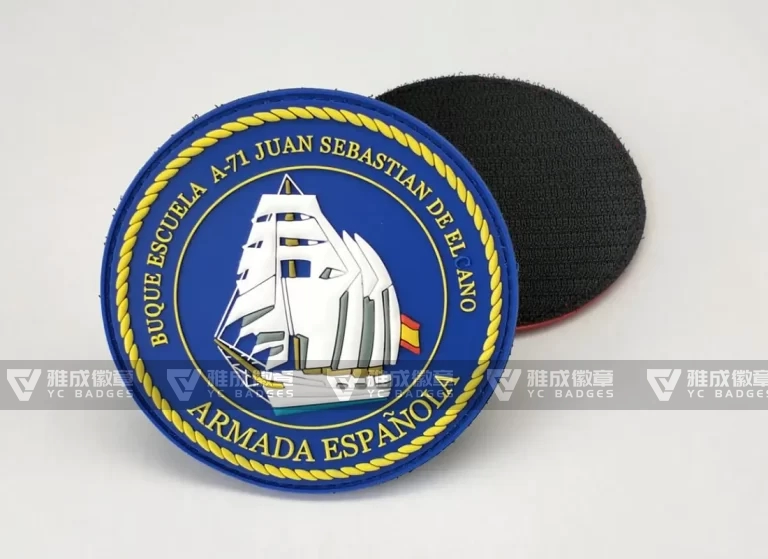
Introduction: Identification Challenges in Maritime Environments
Naval operations present unique challenges that go beyond standard field conditions. Personnel operating at sea must deal with constant exposure to moisture, salt air, wind, and temperature fluctuations. These environmental factors can quickly degrade traditional uniform components, including embroidered patches.
For procurement teams within naval forces, ensuring long-lasting and clearly visible identification is critical. This is why many organizations are shifting toward custom navy pvc patches as a more durable and reliable alternative.
Compared to fabric-based options, military pvc patches offer superior resistance to maritime conditions, making them ideal for shipboard and coastal operations.
Industry Challenge: Why Traditional Patches Fail at Sea
Constant Exposure to Moisture and Salt
At sea, humidity levels are consistently high, and salt particles in the air accelerate material degradation. Embroidered patches tend to:
- Absorb water
- Fade over time
- Fray along the edges
- Lose structural integrity
This leads to frequent replacement cycles and increased operational costs.
Visibility and Identification Issues
Naval personnel often operate in low-visibility conditions such as:
- Night operations
- Foggy environments
- Enclosed ship compartments
In such scenarios, worn-out or faded patches can affect quick identification, which is critical for coordination and safety.
Solution: Why Custom Navy PVC Patches Perform Better
1. Waterproof and Salt-Resistant Material
Custom navy pvc patches are made from molded PVC, a material inherently resistant to water and salt corrosion.
Key benefits include:
- No water absorption
- Resistance to salt air exposure
- No mold or mildew formation
This makes them highly suitable for long-term maritime deployment.
2. Enhanced Durability in Harsh Conditions
Unlike embroidered patches, maritime pvc patches maintain their structure even under:
- Continuous UV exposure
- Strong winds
- Frequent handling
- Mechanical wear
They do not fray or deform, ensuring a consistent appearance throughout their lifecycle.
3. Clear Identification with 3D and High-Contrast Design
Naval operations require clear visual identification.
With 3D pvc patches, units can achieve:
- Raised lettering for better readability
- Distinctive insignia and emblems
- High-contrast color combinations
- Subdued tactical designs when needed
This improves recognition across various operational environments.
4. Velcro Compatibility for Shipboard Flexibility
Modern naval uniforms and gear incorporate Velcro systems for modularity.
Navy velcro patches provide:
- Secure attachment in active conditions
- Quick replacement or repositioning
- Adaptability for mission-specific roles
This flexibility is especially important for multi-role naval crews.
5. Reduced Long-Term Procurement Costs
From a procurement perspective, durability translates into cost savings.
Custom navy pvc patches offer:
- Longer service life
- Fewer replacements
- Consistent quality across batches
This helps naval organizations optimize their equipment budgets.
Common Applications of Navy PVC Patches
Shipboard Identification
Used to identify personnel roles and departments aboard vessels.
Unit and Fleet Insignia
Custom naval patches representing specific fleets, squadrons, or commands.
Tactical Gear Labeling
Applied to vests, jackets, and operational equipment.
Training and Special Operations
Used during maritime exercises and specialized missions.
Design Considerations for Naval PVC Patches
When designing custom naval patches, procurement teams should consider:
- Color schemes: Navy blue, subdued tones, or high-contrast options
- Size: Typically 2–4 inches for visibility and practicality
- Detail level: Optimized for clarity in 3D molding
- Shape: Circular, shield, or custom naval insignia forms
- Backing: Velcro for flexibility and ease of use
A well-optimized design ensures both functionality and visual consistency.
Industry Trend: PVC Patches in Modern Naval Forces
Naval forces across the U.S. and Europe are increasingly adopting PVC patches for operational use.
Key drivers include:
- Transition to modular uniform systems
- Demand for weather-resistant materials
- Standardization across units and fleets
- Integration with modern tactical gear
In many cases, embroidered patches are now reserved for ceremonial uniforms, while military pvc patches are used in active operations.
Choosing a Reliable Navy PVC Patch Manufacturer
Selecting the right manufacturing partner is essential for quality and consistency.
A professional supplier should offer:
- Experience in military and naval patch production
- Accurate color and logo reproduction
- High-quality Velcro backing
- 2D and 3D design capabilities
- Stable bulk production capacity
Working with an experienced OEM manufacturer ensures your patches meet operational standards.
Conclusion: Built for the Demands of Maritime Operations
For naval forces operating in challenging sea environments, custom navy pvc patches provide a practical and durable identification solution.
Their resistance to water, salt, and wear—combined with flexible design and strong attachment—makes them ideal for shipboard and maritime use.
As naval equipment continues to evolve, PVC patches will remain a reliable component of modern uniform systems.
Request a Quote for Custom Navy PVC Patches
If your organization is sourcing:
- Custom Navy PVC patches
- Maritime Velcro patches
- Waterproof military patches
- Bulk naval insignia production
We provide OEM manufacturing solutions tailored to military and maritime applications.
- Free design consultation
- Sample development
- Competitive bulk pricing
- Fast production lead times